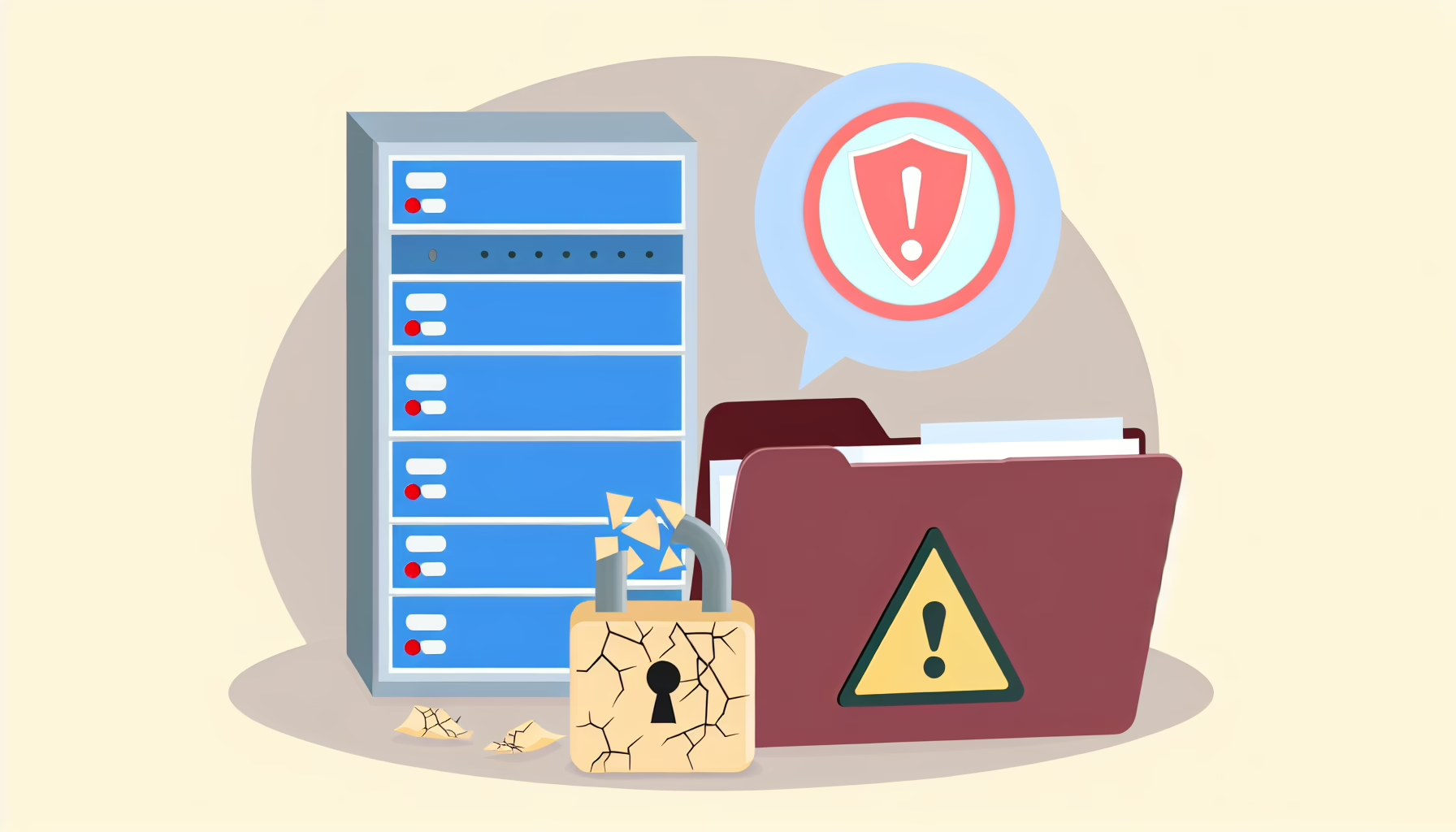
The European Commission is investigating a significant data breach after its Europa.eu web platform was compromised in a cyberattack claimed by the ShinyHunters extortion gang. This is not a story about classified intelligence systems or military networks. It is a story about cloud-hosted web infrastructure — the same category of technology that most businesses, including those running WordPress sites, depend on every day.
The breach targeted the cloud infrastructure hosting the Commission’s web presence on the Europa.eu platform. The Commission confirmed its internal systems were not affected, which might sound reassuring — but that framing should not obscure what actually happened. The public-facing web environment was the target, and it was sufficient to cause a material data loss event. For any organisation that treats its website hosting as a low-risk afterthought, this incident is a direct challenge to that assumption.
Investigators believe the attacker compromised at least one account used to manage the Commission’s cloud environment, which potentially exposed employee information and internal services. A single account. That is the attack surface. Not a sophisticated zero-day exploit against hardened government systems — a compromised cloud management account. CERT-EU was formally notified on 25 March 2026 in accordance with the EU’s own cybersecurity regulation, confirming this was treated as a serious incident from the outset.
The scale of what was accessed makes this considerably more consequential than a defacement or a service outage. The breach potentially affects 42 internal European Commission clients and at least 29 other Union entities using the Europa.eu hosting service, with tens of thousands of files containing personal information, usernames, email addresses, and email content reported as stolen. This matters because it illustrates a point that is easy to overlook: shared cloud hosting environments mean that a single compromised account does not just put one organisation at risk. It puts every client of that environment at risk simultaneously.
The attack hit the cloud computing infrastructure used to manage the Europa.eu platform, where the Commission, European Parliament, Council of the EU, and other EU institutions’ websites are located. The fact that so many separate institutions were exposed through a single cloud environment should give pause to any executive who assumes that because their site sits alongside reputable brands on a managed hosting platform, they are adequately protected.
What the Commission’s response reveals about reputational risk
Early findings confirmed that data had been taken from the Commission’s websites, though no details were provided about what kind of data was taken, how much, or who might be affected. For those whose information was included in the breach, that disclosure is not reassuring — it is alarming precisely because it offers nothing actionable. When an organisation cannot tell affected parties what was taken or what they should do, the reputational damage compounds every day the investigation continues without answers.
This is a consequence that businesses of every size face when they lack the visibility to understand what has actually been accessed during a breach. It is not simply a technical failure — it becomes a communications failure, a trust failure, and often a regulatory exposure. The Commission, with all its resources, found itself unable to provide a clear account of events in the immediate aftermath. Smaller organisations, with fewer staff and less sophisticated logging, frequently face the same situation and have fewer means to recover from it.
What this means for your WordPress and cloud hosting environment
If your business runs a WordPress site on a managed or cloud hosting environment, the Commission incident raises questions worth addressing directly:
- Who has access to your hosting accounts? Former employees, agencies, and contractors often retain credentials long after their involvement ends. Access should be reviewed and revoked systematically, not reactively.
- Are cloud management accounts protected by multi-factor authentication? A compromised password alone should not be sufficient to access your hosting environment, your DNS settings, or your file storage.
- Do you have logging and alerting in place? Without activity logs, you cannot detect anomalous access — and without alerting, you cannot respond before damage is done.
- Do you know what data your web environment holds? Contact form submissions, user registrations, e-commerce records, and uploaded documents can all accumulate over time without active management. You cannot disclose what was taken if you do not know what was there.
- Is your hosting provider’s security posture one you have actually verified? The fact that a platform hosts well-known clients is not, by itself, evidence of adequate security controls.
The European Commission is not a careless organisation. It operates under stringent regulatory requirements and employs dedicated security professionals. That a single compromised cloud account was still sufficient to result in tens of thousands of files being exfiltrated across dozens of institutions is a measured indication of how accessible this type of attack has become, and how significant the consequences can be even when core internal systems remain untouched.
If you want to understand who currently has access to your WordPress hosting environment, what controls are in place to detect unusual activity, and whether your current setup would contain a breach before it escalated — that is exactly the kind of review my work at The WordPress Guy is designed to support. Start with access. Everything else follows from there.